



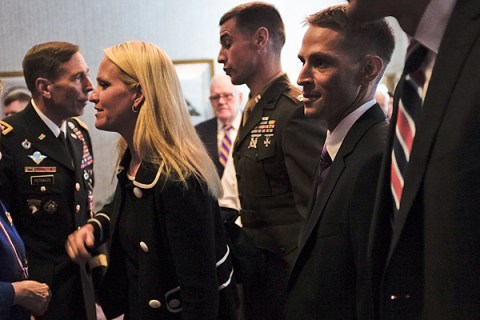
Alex Lemons (second from right, in tie), a one-time Marine scout sniper, stands in a receiving line to greet General David Petraeus (far left) after Petraeus' retirement from the Army, Aug. 31, 2011, in Arlington, Virginia.
Alex Lemons, a former Marine sergeant who deployed to Iraq three times – including once as scout sniper – reflects on the video of four Marines urinating on the corpses of three dead Taliban in Afghanistan:
This is all very painful to me on so many different levels. Back in 2004 one of my fellow snipers shot someone in a mosque in Fallujah. You will probably remember it getting on TV. It was very confusing. I have tried stopping things like this before or I’ve been a coward and let them happen.
In my eyes, there are several discomforting or significant things about this event:
— If you aren’t surprised and disgusted by this as a combatant, veteran or as a civilian whose country has been at war for a decade, then maybe you need to take a look in the mirror. Have you become this callous?
— I’d like to know how many tours those grunts have been on. Do we know what condition they are in mentally? Are any on medications?
— This happened a lot in Fallujah II 2004 and I have a couple explanations. There were a lot of kids who imitated things they saw or read in Vietnam War films or literature. You always look back on the last war to explain your own.
Sometimes, Marines needed to take pictures and laugh about the death swirling around them because if they took it seriously and grieved then they would not be able to function and continue the fight.
Sometimes, Marines were simply brutal and took trophy photos or pissed or defecated on bodies because it actually felt good after you had been fighting someone for a hour or a day.
Maybe it was also the kind of fighting, insurgency, that produced experiences like this. You fight ghosts (IEDs, booby traps, snipers, potshots, loudspeaker recordings) and when you finally get one enemy grunt who isn’t even in a uniform you choose to take out all the frustrations of fighting an invisible enemy on a lifeless but symbolic corpse.
— Events like this have the power of a stone thrown into a calm lake. The circumstances and people that created the rippling effects are irrelevant. We don’t know who the dead men are, if they had weapons or if they were simply pushing that wheelbarrow around. It’s too late to ask those questions outside of a tribunal.
Anyone looking at the United States presence is going to hold this up as a symbol for all our actions past, present and future. That might sound like too high of a standard to measure ourselves against, but purportedly this is the principle we stand for and fight on.
— War is not a moral agent. “War is hell, shit happens and trophies get taken,” is a copout from an irresponsible person. War doesn’t make anyone do anything because it is not a living thing.
People make war and they make choices in war. Most of these choices are made along the lines of rules of engagement, other war conventions, and training.
The Marine Corps doesn’t teach anyone to do this.
Choices were made and they were not good ones. This is what maintains our moral high ground. It doesn’t matter if the Taliban cut heads off and videotape them.
The whole point, as I was told since 2001, was not to become like them, or to be comparable to them.