



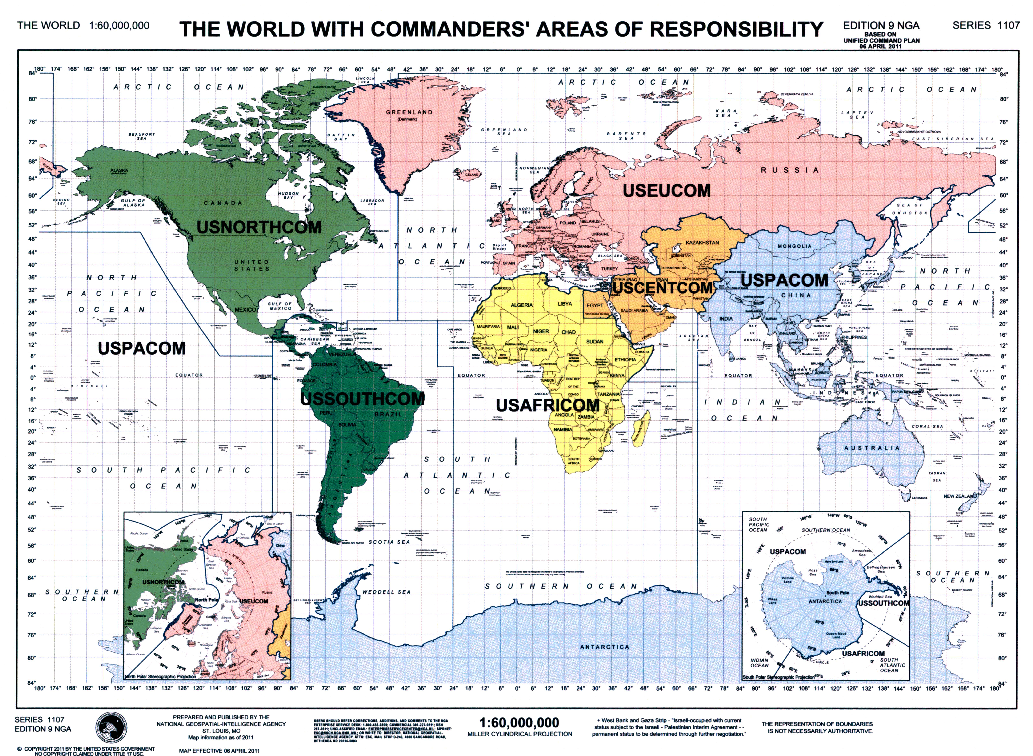
"The missions it is assigned": It may be time to redraw the map / DoD
The Joint Select Committee on Deficit Reduction’s failure to come up with a dime – never mind $1.2 trillion – in deficit reduction over the coming decade has set the stage for both tragedy – if you’re a defense secretary given to supersonic flights of rhetoric – and farce, if you’re an American taxpayer.
That failure – the so-called super-committee’s formal deadline is Wednesday, but its red-tape Washington deadline was Monday – puts crosshairs squarely over the Pentagon.
Half of that $1.2 trillion in cuts, under the law passed in August, has to come from the “050 accounts” – which overwhelmingly means the Pentagon. Other defense-related agencies, like the Energy Department’s nuke-building division, fall under the 050 umbrella, meaning the Pentagon won’t have to come up with all $600 billion in cuts over the coming decade.
But the law that set up this sequester mechanism delayed its impact by more than a year: these cuts won’t be made under the law until the decade beginning January 2013. That gives the Pentagon and the rest of the executive branch 13 months to divvy up the $1.2 trillion in deficit reduction voluntarily. “We would have a year where sequester would hang as a shadow over this department,” Defense Secretary Leon Panetta said November 10. Well, the shadow is darkening.
There’s an outside chance that the government could come up with a budget trimming $1.2 trillion smartly on its own; if that doesn’t happen, the cuts will fall across the board, meaning the government won’t be able to cut some areas more deeply so it can protect others. Exceptions: war spending is protected, and military personnel costs can be protected, if deeper cuts are made elsewhere. But despite the sturm und drang, cuts under sequestration would only peel the Pentagon back to its 2007 spending level – a year well above the Cold War average.
Following the super-committee’s failure, Panetta said sequestration “will tear a seam in the nation’s defense.” On Capitol Hill, Rep. Howard McKeon, R-Calif., chairman of the armed services committee, said he would introduce legislation to stop the sequestration cuts from hitting the Pentagon. Those cuts would be in addition to an already agreed-upon $450 billion over the next decade from the Pentagon’s budget plans (it wouldn’t actually be a cut; it would only slow down the rate of growth in its budget). “Unfortunately, America’s military is facing cuts that will devastate the armed forces and force us to break faith with service members,” McKeon said. “I will not let these sequestration cuts stand.”
But President Obama made it clear he will veto any move by Congress to create “easy off-ramps” to spare the Pentagon from sequester. Nonwithstanding all of his doomsday warnings, Panetta agreed. “Despite the danger posed by sequestration, I join the President in his call for Congress to avoid an easy way out of this crisis,” he said, before stumbling upon the Rosetta stone: “The half-trillion in additional cuts demanded by sequester would lead to a hollow force incapable of sustaining the missions it is assigned.”
Panetta, apparently inadvertently, hit the bulls-eye: sustaining the missions it is assigned.
As we reported back in April, cuts of this magnitude will require adjustments in what we ask the military to do. Instead of continued arguing over the size of the budget, it’s plain the hieroglyphics are on the wall: isn’t it time to start debating the size of the missions?