



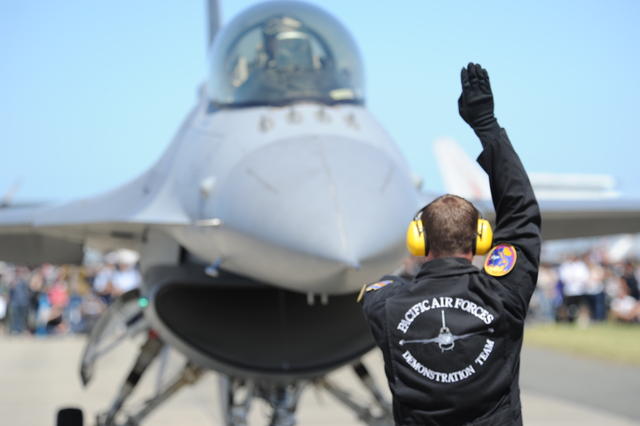
This U.S. F-16, shown in Australia earlier this year, is going to be joined by many more / Air Force photo by Cohen A. Young
The U.S. is shipping 250 Marines to Australia by the middle of next year, a force that eventually will grow to 2,500. U.S. Air Force units will increasingly cycle in an out of bases in northern Australia – a full Marine Air-Ground Task Force. A MAGTF — pronounced mag-taff — is the Marines’ key unit for conducting missions across the range of military operations, providing commanders with what the crops calls “scalable, versatile expeditionary forces.”
Like a geopolitical seesaw, the U.S. military is tilting its forces away from Europe – where they have been since World War II as a counter to the Soviet Union – to the Pacific, where they will help serve to calm regional fears about China’s growing military might. Beijing has been poking around the South China Sea in recent years. More than $6 trillion in goods ships through the sea annually, and the U.S. and its allies want to ensure it remains open to navigation and doesn’t become a Chinese lake. “I think the notion that we fear China is mistaken.” President Obama said in Canberra as he announced the increased U.S. military presence alongside Australian Prime Minister Julia Gillard. “The notion that we’re looking to exclude China is mistaken.”
Nonetheless, China was predictably skittish about the stepped-up U.S. military presence in its neighborhood. “The United States is also trying to get involved in a number of regional maritime disputes, some of which concern China’s sovereignty and territorial integrity,” China’s official Xinhua news agency said. “While determined to become more involved in Asia-Pacific regional affairs, the United States perhaps also should appreciate the constructive role it is expected to play in the area and respect the rights and interests of each and every regional member.”
Defense Secretary Leon Panetta said in September that the pact represents “a clear signal to the Asia-Pacific region that the United States and Australia are going to continue to work together to make very clear to those that would threaten us that we’re going to stick together.”
Australians like Obama and the U.S.; a summertime poll showed that 55% of Australians approved of allowing U.S. forces to be based in their country, and 82% said the 60-year old alliance between the two nations is important to Australia’s security. It’s along way from Vietnam, where – under U.S. pressure – the Australians sent nearly 60,000 troops off to war, more than 500 of whom never came home.