



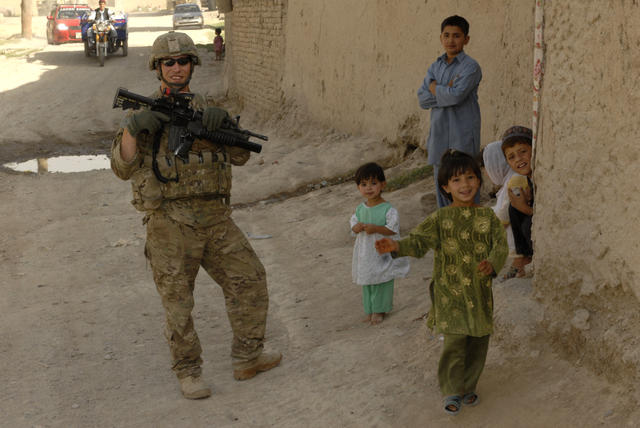
A U.S. soldier pals around with Afghan kids in Kandahar / Army photo by Breanne Pye
Bill Ardolino over at Small Wars Journal reports the impact the already-underway U.S. troop pullout from Afghanistan is having in the violent eastern part of the country. He doesn’t like what he sees:
…in truth, the Obama administration’s accelerated drawdown of US forces has undercut a needed infusion of forces from RC South to the Afghan east that was an unspoken second act to the US military’s ‘surge’ strategy for the stabilization of Afghanistan. The resulting resource issue has forced US forces to short shrift counterinsurgency doctrine: instead of living amongst the locals, troops attempt to woo an apathetic and sometimes hostile population from centralized combat outposts, while members of the Taliban, the Haqqani Network, Hizb-i-Islami Gulbuddin (HIG), and other insurgent and criminal patronage networks continue to exercise daily influence over the population.
The result is a strategy employing muscular offensive operations (that some delineate with the label “Counter-Terrorism” – CT) with other components of Counterinsurgency (COIN) doctrine. The offensive aspect seems potent; most Afghan and US military officials at various levels agree that an incessant string of special operations forces night raids and conventional offensive operations are pressuring insurgent groups and bleeding their leadership, especially the ranks of middle-management. But the execution and impact of other counterinsurgency aspects are dubious. If true COIN doctrine is a delicate symphony that requires all components to be playing in time and tune, the strategy in RC East is currently missing a few instruments.
…US strategy in Afghanistan remains conflicted and lacks a clear path to success.
Ardolino is an adjunct fellow at the rightward-tilting Foundation for the Defense of Democracies. It’s a safe bet those looking to hammer President Obama’s Afghan policy in the 2012 campaign are reading his words closely.