



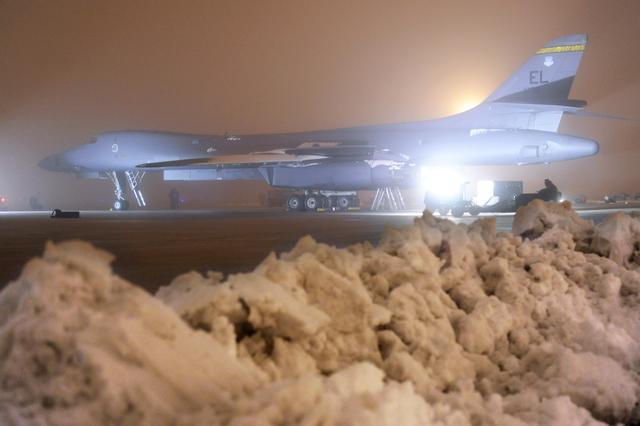
A U.S. B-1 bomber readies to fly to Libya from its South Dakota base in the war's opening hours last March / Air Force photo by Marc I. Lane
Now that Moammar Gaddafi has been consigned to history, it’s time to figure out who — other than the Libyan people, hopefully — wins from the seven-month fight that toppled his 42-year regime.
As we noted Thursday — and was echoed Friday in the New York Times and Washington Post, among other foghorns — President Obama gets credit for deftly negotiating the war’s shoals. That also means NATO comes in for praise — it wasn’t only Battleland wondering just how long this campaign was going to last during last summer’s fitful bombing spurts.
All of which combine to limn a new role for the U.S.
Sure, every conflict is different, but it is hard to criticize a humanitarian-inspired war — led by the Europeans — that ends with a dictator deposed and no loss of allied life.
American power — specifically, American air power — proved decisive. It highlights the value of bringing unique U.S. technology to bear, while relinquishing some elements of command in exchange for allies doing more. Just as American bombers began the war by attacking Libya, a U.S. Predator — backed by French warplanes — ended it by striking Gaddafi’s convoy as he tried to flee his Sirte stronghold Thursday morning.
NATO has issued a summary of its role in Gaddafi’s final act:
At approximately 08h30 local time (GMT+2) on Thursday 20 October 2011, NATO aircraft struck 11 armed military vehicles which were part of a larger group of approximately 75 vehicles manoeuvring in the vicinity of Sirte. These vehicles were leaving Sirte at high speed and were attempting to force their way around the outskirts of the city. The vehicles had a substantial amount of mounted weapons and ammunition, posing a significant threat to the local civilian population…The convoy was engaged by NATO aircraft to reduce the threat. Initially, only one vehicle was destroyed, which disrupted the convoy and resulted in many vehicles dispersing and changing direction…At the time of the strike, NATO did not know that Qadhafi was in the convoy. NATO’s intervention was conducted solely to reduce the threat towards the civilian population, as required to do under our UN mandate. As a matter of policy, NATO does not target individuals.
All told, as of Thursday, NATO has carried out 26,156 sorties over Libya, including 9,634 ground-attack missions. The alliance’s’s Operation Unified Protector will wind down in the coming days. The real challenge — building a functioning nation out of the shards of Gaddafi’s Libya — will then begin in earnest.
But the key takeaway, militarily-speaking, is that the bulk of the war was handled by European nations. There was grumbling among some U.S. officials as the Libyan operation dragged on, but heck — they’ve also been complaining about Afghanistan for years.
“We have been used to the fact that the U.S. should be in the very front line, and absolutely be in the lead, to carry out NATO operations,” NATO Secretary General Anders Fogh Rasmussen told Battleland mid-war. “How could it be that the U.S. should always take the lion’s share of the burden — couldn’t European allies step up to the plate?”
They did. And they scored.