



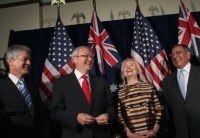
U.S. Secretary of State Hillary Clinton and U.S. Secretary of Defense Leon Panetta, right, share a laugh with Australian Foreign Minister Kevin Rudd and Australian Defence Minister Stephen Smith, far left, during US-Australia defense talks Sept. 14
TOKYO – It was all smiles and bonhomie at the US-Australia defense meetings in San Francisco this month. But Down Under, there are growing calls for Australia to scale back its reliance on America in favor of – you guessed it – China.
“Australia can no longer assume that we can continue to exist in a world where we can rely on our great and powerful friend the United States to ensure our strategic future, and at the same time continue to have a very strong and growing economic relationship with China,” says Danielle Chubb, an Australian defense specialists and Vasey Fellow at the Pacific Forum CSIS in Honolulu. “As China grows – which is something Australia wants — it is going to demand greater influence in the region.”
It’s no surprise Australians are twitchy.
China is now Australia’s largest trading partner, with exports tripling since 2005 to almost $60 billion a year. While much of the world has slipped into recession twice in the past decade, Australia has avoided a downturn, thanks mostly to the mountains of coal and iron ore heading to China.
All this comes even as China is rapidly modernizing its navy and air force, and making aggressive – if not combative — territorial claims in Asian waters.
 By comparison, the United States has been busy with wars in Iraq and Afghanistan and has seen its enormous military advantage over China begin to slip.
“In some ways the United States has taken its eyes off the ball in Asia,” says Raoul Heinrichs, a Sir Arthur Tange scholar at Australian National University’s Strategic and Defence Studies Centre.
“It’s spent the last 10 years in Afghanistan chasing after bandits in mud huts while an emerging major power has been amassing advanced weapons and technology. It’s a dangerous situation and one that could lead to quite intense strategic competition.”
Heinrichs says Australia should reduce its reliance on the US, build up its own military capabilities and develop closer relations with China. Australia spends just 2.4 percent of its GDP on defense, compared to more than 4 percent in the US, and has a standing military of just 50,000 men and women.
Heinrichs says Australia failed to recognize the decline of Britain and rise of Japan prior to World War II, and was saved only by the timely intervention of the Americans.
“I’m not saying we should pack up the US alliance and shut it all down and head off to Beijing. But by depending on the (US) alliance to such a degree, we risk being drawn into conflicts we might otherwise stay out of, or be left to chance if our partners aren’t there when we need them, which has happened before,” Heinrichs says.
It’s not clear how many are listening.
At the AUSMIN defense meetings in San Francisco this month, officials pledged to strengthen the 60-year-old alliance between Australia and the United States. They announced plans to grant US forces increased access to Australian naval and air bases; boost joint training exercises; preposition US equipment; and increase intelligence and cyber-warfare cooperation.
“My goal is to make clear that the United States will always maintain a very strong presence in that part of the world and that we will fulfill our commitments to Australia and all of our allies … (and) to make very certain that the countries in the Asia-Pacific region understand that we are there to stay,” US Defense Secretary Leon Panetta said.
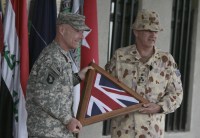
US Lt. Gen. Frank Helmick, left, and Australia's Brig. Gen. David McGahey during ceremonies marking the end of Australia’s participation in the Iraq war in Baghdad in 2009. Australians have fought alongside US troops in virtually every major conflict since World War II. / Getty
That goes down well with most Australians, says Michael Sutton, an Asia specialist at Aoyama Gakuin University in Tokyo.
Language and cultural ties, shared democratic values and residual goodwill from World War II means most Australians want to keep the alliance with American, even as China grows in power and influence.
“Australia goes through these very delicate dances whenever there’s an emerging new country in Asia, and now it is going through the dance with China. But that won’t affect the fundamental relationship between Australia and the United States,” says Sutton.
Still, the agreements announced with such fanfare in San Francisco this month may be less than they seem. The Americans will not maintain a permanent military presence in Australia. They will not operate their own bases – as they do in Japan and South Korea — nor will any new bases be built for them.
“We are not looking at additional or new facilities,” said Australia Defense Minister Stephen Smith. “We are looking at the sharing of our current facilities.”
US President Obama is scheduled to make his first visit to Australia in November. Details of the agreements could be announced then.
Danielle Chubb says that for now, the issue remains largely an academic debate. Most Australians remain committed to the alliance with the United States. But as Australia’s future becomes increasingly tied to China, Australians could face difficult choices.
“Will China start asking Australia hard questions about where it sees its loyalties? If we choose a greater US presence in the region, will we see China point its (military) capabilities toward Australia?” Chubb asks. “Or do we need to talk about abandoning the alliance? This is something that shakes most Australians to the core.”