



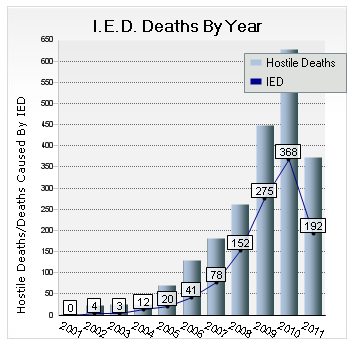
IED deaths in Afghanistan / iCasualties.org
After years of climbing, it looks like combat deaths due to roadside bombs in Afghanistan are on the decline. That’s good news, because such improvised explosive devices — IEDs — have been the biggest killer of U.S. troops. IEDs are a continual game of cat-and-mouse. When pressure-sensitive IEDs kept killing too many innocent civilians, the Taliban shifted to detonating them with electronic signals. That served two purposes: it let the triggerman allow civilian vehicles to pass safely, and it also let him time the explosion so the increasingly-sophisticated shaped-charged IEDs would do the most damage to the target vehicle.
But every advance on the battlefield exposes weaknesses the enemy exploits. Bruce Carlson, who runs the National Reconnaissance Office, detailed a largely secret but effective way the U.S. is now blunting these roadside killers Thursday.
“We do a lot of work to make sure that we know what those [detonating] signals are, and where they’re coming from, and to geolocate them,” says Carlson, a retired Air Force general. “We have a program we call `Red Dot’ — and the reason it’s called Red Dot is because that’s what it puts on a display in a Humvee or command post that says: at this red dot we have a high probability that there’s an IED there.”
Which raises a basic question: how do you intercept an IED that you track using its electronic detonating signal in time to do any good? Carlson clams up when it comes to gritty details like that, but it’s plain that it involves meshing transmission fingerprints with overhead imagery and other signals intelligence to deduce — if not pinpoint — where an IED has been planted. “I can’t tell you exactly how we do that, but it’s a pretty clever set of technologies,” Carlson says. “What it has meant is even though we still have an unacceptable loss from IEDs, we are catching a lot of them before they’re detonated.”
Bottom line: for the past six months, soldiers traveling in Humvees or MRAPs along Afghan roads have red dots popping up on their computer screens warning them of areas to avoid or where to look to hunt down suspected IEDs. There are a lot of “false positives” flowing into NRO command centers, but most are weeded out before suspected IED sites are dispatched to troops on the front lines. “We try to make sure that we balance between conservatism and driving people crazy — if you just put a red dot every mile, nothing gets done,” Carlson says. “We’ve screwed a few up, and given them a few extra red dots, but I would say it’s been about 80% effective.”