



The militant Islamic group of north Nigeria, known as Boko Harum, takes credit for the deadly car-bomb attack on a police station in the capital city of Abuja yesterday.
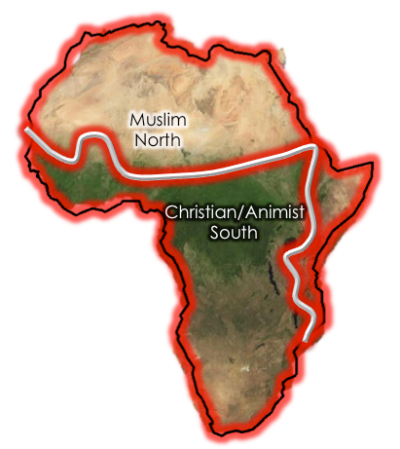
You might not think of West Africa as a likely site for radical Muslim violence, but the map on the left, which I use in my current “global futures” brief, may clear things up a bit when you hear about this, the recent north-south election standoff in Ivory Coast, or al-Shabaab violence extending over to Uganda.
The Nigerian north-south standoff was perfectly captured in this year’s presidential vote: Muslim candidate wins all the northern states, while Christian Jonathan Goodluck wins all the southern ones.
There is a profound environmental divide in Africa that corresponds to a religious divide:
- Muslims in the arid north;
- Christians in the more fertile heartland.
As the radical Islamic pulse continues to fail/peter out in the Middle East and North Africa, this is where it comes next.
Why? Globalization is penetrating Africa big-time, mostly driven by ravenous Chinese resource demands, and the socio-economic churn creates potential conflicts that radical Islamists will seek to exploit. So yeah, AFRICOM becomes more important over time.