



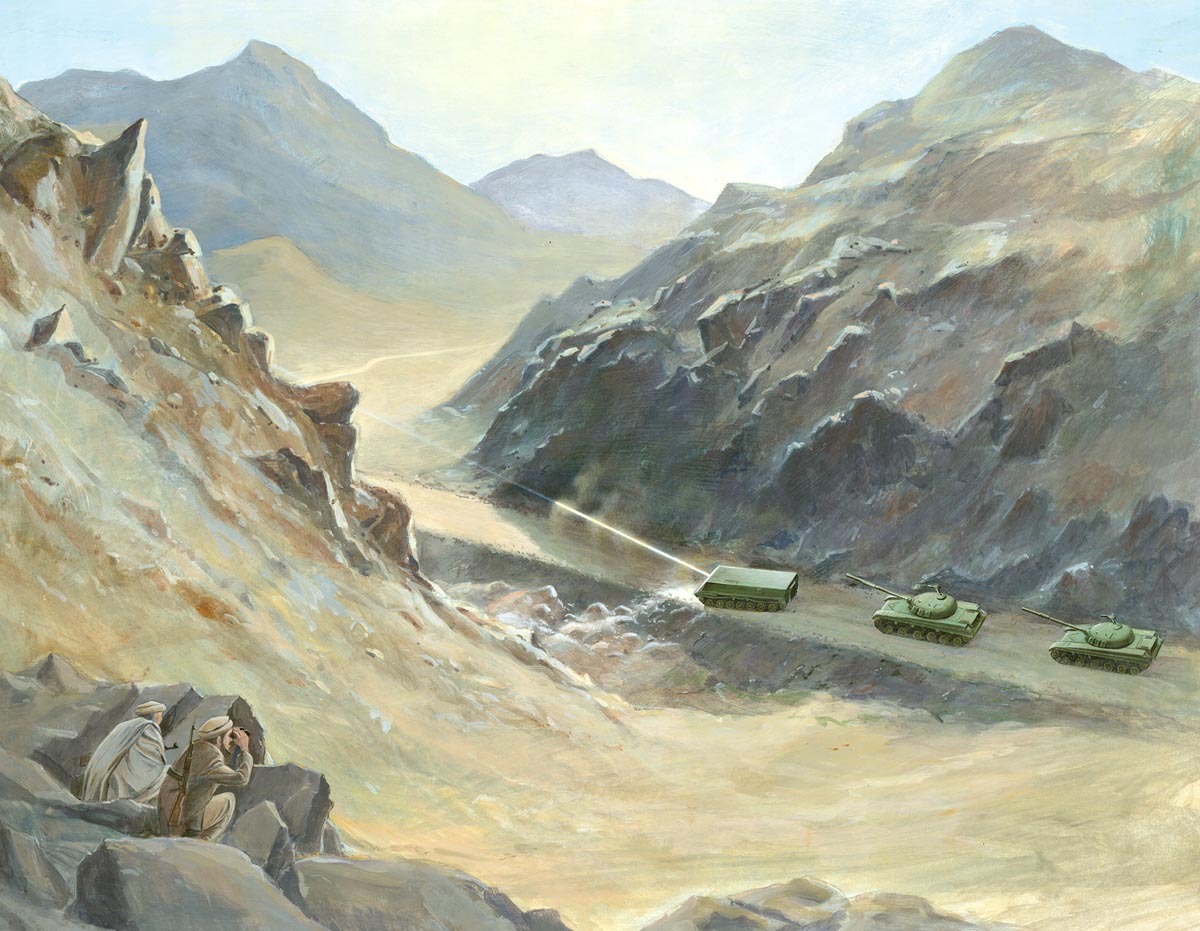
Deja View: From the Pentagon's 1985 report on the Soviet threat: "Soviet Mobile Laser in Afghanistan" / DIA
Make no mistake about it: China remains the U.S.’s No. 1 foe — with a bullet. In its annual kabuki dance Wednesday, the Pentagon issued its latest version of its assessment of China’s military might, mandated by Congress. The 84-page report focused like a laser on what the Pentagon sees as China’s push for naval and air power in the western Pacific, including stealth warplanes, aircraft carriers, and longer-range ballistic missiles.
“The pace and scope of China’s sustained military investment have allowed China to pursue capabilities that we believe are potentially destabilizing to regional military balances, increase the risk of misunderstanding and miscalculation, and may contribute to regional tensions and anxieties,” Deputy Assistant Secretary of Defense for East Asia Michael Schiffer told reporters as he released the study. “Such capabilities could increase Beijing’s options for using military force to gain diplomatic advantage, advance its interests or resolve military disputes in its favor.”
If you’re old enough, you may recall a similar exercise from the 1980s, when Defense Secretary Caspar Weinberger would release a volume called Soviet Military Power each year around budget time to scare more money out of Congress. Guess what: it worked.
Plainly, the Soviet Union made for a good foe. When it disappeared, we needed to come up with another. That’s not a dig; it seems humans have always needed to survey their horizon and suss out where trouble is likely to loom next.
So, by dint of manpower and money, China is the only game in town, well ahead of rogue states like Iran and North Korea. But unlike the Soviet Union — which produced nothing Americans wanted — China produces all of our latest high-tech gadgets, as well as lots of other everyday items ranging from shoes to clothes to tools. Walmart couldn’t exist without China — and neither could Apple and its iPods, iPads and Macs.
Part of the military’s job is to anticipate threats and prepare to meet them. But sometimes it seems we do a better job of anticipating threats than actually dealing with them. Here’s another point of view: Foreign Policy magazine just detailed seven thought-provoking facts about wars that many of us believe, but that it contends are misleading, if not completely wrong.
Bottom line: Take the Pentagon’s Military and Security Developments Involving the People’s Republic of China with a grain of MSG. It helps if you can pull one of those tattered copies of Cap’s Soviet Military Power off your bookshelf and flip through its pages. I have one up there, just to keep me honest.
Be sure to check out the paintings they contained (the Chinese version released Wednesday is artless). The Defense Intelligence Agency ordered its artists (who knew?) to paint Igor Bond-like super-weapons from spy photographs – the better to blur just how much we really “knew.” The Pentagon, in turn, used those paintings to illustrate its annual editions of Soviet Military Power. In honor of its 35th anniversary, DIA turned a bunch of the paintings into posters several years ago, 10 of which now grace my office walls.
Think of it as the military-industrial complex’s Peter Max moment. My favorite? The handsome 1985 landscape labeled “Soviet Mobile Laser in Afghanistan,” complete with a couple of Taliban-like insurgents crouched behind rocks in the foreground, invisible to the Soviet laser-mobiles down in the valley below. A quarter-century later, there’s no Soviet Union. There’s no mobile lasers. But one thing artist Edward L. Cooper got right: there is a superpower struggling to get out of Afghanistan.