



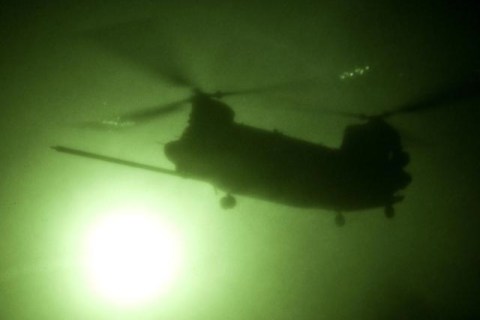
The downed chopper was a CH-47 like this.
A deadly golden BB apparently found its target over Afghanistan early Saturday, killing 31 U.S. special operations troops and seven Afghan along for the mission to learn from the best. The “golden BB” is the combat aviator’s worst nightmare: a lucky shot that – if it hits in the right place – can doom a helicopter and all aboard. Helicopters are more vulnerable than fixed-wing aircraft; they fly slower, and their mechanical parts – a tail rotor, mechanical shaft or fuel tanks, for example – more likely to lead to disaster when struck.
The downing of the CH-47 Chinook in Wardak Province west of Kabul – likely by a Taliban-fired rocket-propelled grenade – marked the single deadliest day for U.S. forces in Afghanistan since the war began nearly a decade ago. “Their deaths,” President Obama said of those lost, “are a reminder of the extraordinary sacrifice made by the men and women of our military and their families.” The attack occurred far from the Pakistan frontier, and most insurgents in the region are local, highlighting the stubbornness of the fight. The downing happens just as the U.S. begins shrinking its 100,000-strong troop presence in the country.
A five-member Army crew was ferrying about two dozen Navy SEALs on a rescue mission to aid allied troops under Taliban fire when a well-placed shot brought the chopper down, a Pentagon official said. Three Air Force spotters, along with an interpreter, a dog-handler – and a military working dog – also died in the crash. Initial indications were that most of the SEALs who died were members of the elite SEAL Team 6. But they included none of that unit’s members who killed Osama bin Laden on a nighttime raid deep inside Pakistan May 2. The total SEAL force numbers about 2,500.
(See pictures of Afghanistan’s spring fighting season.)
The shootdown happened during a night-time special-ops mission – ideal for sneak attacks, but also dangerous for pilots and their passengers. The chopper’s commandos were coming to aid fellow troops engaged in a firefight that killed eight insurgents not far from Kabul, and were flying low and slow, within easy reach of RPGs, when the golden BB hit home.
Helicopters are vital to waging war in Afghanistan’s rugged terrain. But the country’s mountains, the resulting thinner air that makes it more risky to fly, and the utility of darkness for Special Operations missions like the one that crashed, are a dangerous combination. Helicopter crashes – overwhelmingly brought down by mechanical failures or crew error, and not hostile fire – have accounted for about 10% of the 1,725 U.S. fatalities in the decade-long war.
The Taliban’s growing footprint has forced the U.S. to be far more reliant on moving troops and supplies by air. And the rugged terrain often makes helicopters the only option, even as the altitudes involved greatly increase the risks. Afghanistan’s few roads are now increasingly monitored — and mined — by insurgents, meaning that many of the scores of U.S. outposts spread across the country can only be reached by helicopters. That forces the U.S. military to rely on helicopters, not only to reach remote outposts, but also to carry out dangerous combat missions that thinly spread troops couldn’t do without the helicopter’s ability to hopscotch hundreds of miles.
(See TIME’s special report “Gears of War: Inside America’s Incredible Military Arsenal.”)
Helicopters are swift but delicate machines. The physics of flight make them inherently unstable, and therefore less reliable, than fixed-wing aircraft that generate their lift from stationary wings instead of egg-beater-like rotor blades. More critically, chopper pilots are commonly expected to fly in hot weather at high altitudes, where less-dense air offers them less control over their aircraft.
Air Force Captain Matthew Miller wrote about the challenges of flying in Afghanistan after returning from a four-month deployment there in 2007. His medevac unit, from Georgia’s Moody Air Force Base, had lost three helicopters and seven crew members in the two wars. Enemy fire had been a factor in none of the Afghan crashes.
“In Iraq, helicopter pilots face a greater prospect of being shot at by ground fire,” Miller wrote. “In Afghanistan, the greatest threat is the terrain.” He described flying in Afghanistan as “‘graduate level’ piloting more challenging than cruising over the flatlands of Iraq. “It didn’t take long to feel the perils of mountainous flying in Afghanistan,” he added. “Between Iraq and Afghanistan, most helicopter pilots I’ve spoken to consider Afghanistan the more dangerous place to fly.”