



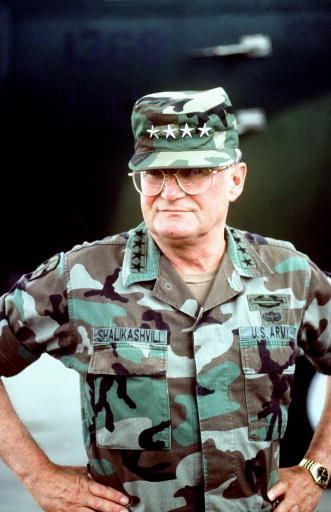
Gen. John Shalikashvili, 1994
When Army General John Shalikashvili’s became chairman of the Joint Chiefs of Staff in 1993, even his staff didn’t know how to say his name. “I’m saying it the way the other people on my staff are saying it: shah-lee-KASH-villy, with the emphasis on the KASH,” said Maj. Nino Fabiano, a spokesman for the Joint Chiefs. “But let me confirm that.” After hours of investigation – and mispronunciations heard around the world — Fabiano reported back: “It’s sholly-kosh-VEE-lee.”
That’s why President Bill Clinton simply called him “General Shali” when he tapped the Polish-born U.S. Army general to head the U.S. military 18 summers ago. “He is a soldier’s soldier,” Clinton declared of the artillery officer who commanded NATO forces in Europe before become chairman, “the right man to lead our forces in this challenging era.”
Shalikashvili, like the President who appointed him, was a bridge between two worlds. Clinton had dodged military service during the Vietnam War, and could only have been elected President because the Cold War was over. Shalikashvili was the first – and only – foreign-born American to serve as chairman of the Joint Chiefs. Born in Warsaw to Georgian parents, he came to the U.S. at 16. He liked to say, only somewhat jokingly, that he mastered English by watching John Wayne movies.
His tenure was fairly placid, which is what his boss, the President, wanted most. Clinton’s first term, following his push to let openly gay men and women serve in the military, practically led to a revolt among the Joint Chiefs and got his relations with the military off to a poor start. “He never minced words, he never postured or pulled punches, he never shied away from tough issues or tough calls, and most important, he never shied away from doing what he believed was the right thing,” Clinton told the AP following Shalikashili’s death Saturday morning.
“Shali’s life was an `only in America’ story,” President Obama said in a statement. “By any measure, he made our country a safer and better place.” The general died in a military hospital in Washington state of complications from a stroke. He was 75, and is survived by his wife and son.
Having lived through the horrors of World War II in Poland, Shalikashvili criticized Western foot-dragging in dealing with Balkan bloodshed, and led Operation Provide Comfort, where allied troops moved into northern Iraq following the first Gulf War in 1991 to protect the Kurds from Saddam Hussein’s post-war wrath.
He served as chairman until 1997 and oversaw U.S. operations in the Balkans and Haiti, but missed the drama of those who filled the office before and after him. The battle of Mogadishu – Black Hawk Down – happened three weeks before he took office, just after Colin Powell stepped down and while Navy Admiral David Jeremiah filled the slot on an interim basis for 23 days. Army General Hugh Shelton succeeded Shalikashvili; Shelton retired September 30, 2001, three weeks after 9/11.