



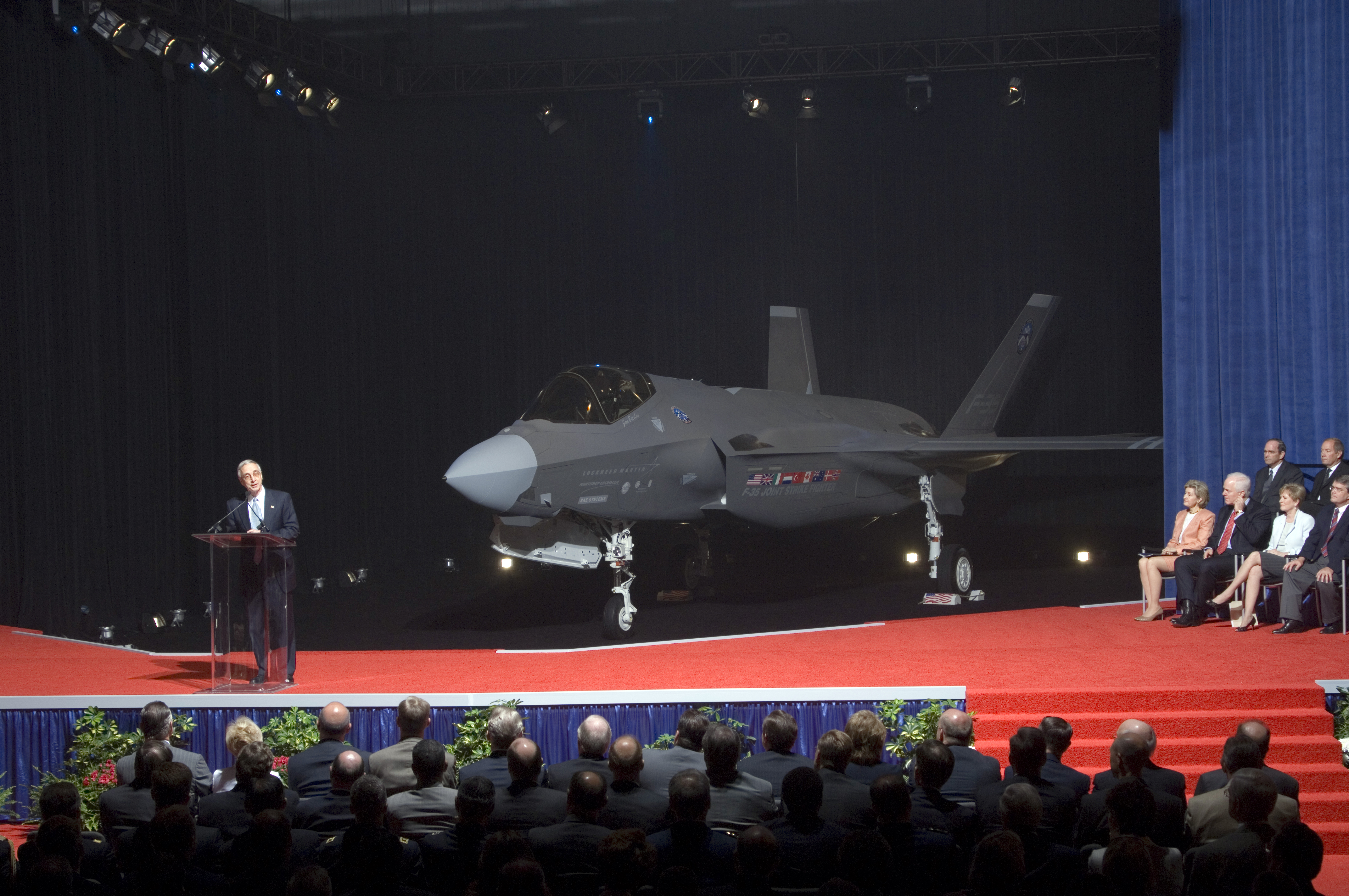
Deputy Defense Secretary Gordon England unveils the F-35 fighter in 2006 -- in the Fort Worth factory he ran for both General Dynamics and Lockheed / Lockheed photo
Gordon England is highly regarded in defense circles, which is why he got space in Friday’s New York Times to detail how he thinks Defense Secretary Leon Panetta should trim Pentagon spending. Yet the op-ed page only said he “served during the administration of George W. Bush as secretary of the Navy and deputy secretary of defense.”
But those jobs were rewards for a career spent in the defense industry. Once you realize where England spent his formative years (Honeywell, Litton, General Dynamics, Lockheed), the column makes a lot more sense. That’s why Battleland, as a public service, is providing this annotated version of England’s recommendations:
Mr. Panetta should first cut the department’s civilian workforce before reducing the size of the military force…And there should be no additional outsourcing, thereby forcing the Pentagon to operate more efficiently.
The Pentagon has out-sourced so many engineers and accountants that the Pentagon inspector general earlier this week complained that in one case contractors were giving orders to government civilians and colluding on contracting specs to ensure they won additional contracts.
Second, Washington must do more to encourage the sale of defense equipment to our friends and allies abroad, like the littoral combat ship, the mine-resistant ambush-protected armored vehicle and a host of other combat and combat-support equipment.
As head of General Dynamics’ — later Lockheed’s — Fort Worth division, England oversaw the sale of F-16 jets around the world. In addition to the U.S. Air Force, nations flying the F-16 include Bahrain, Belgium, Chile, Denmark, Egypt, Greece, Indonesia, Israel, Italy, Jordan, Morocco, the Netherlands, Norway Oman, Pakistan, Poland, Portugal, Singapore, South Korea, Taiwan, Thailand, Turkey, United Arab Emirates and Venezuela.
Third, the Pentagon should put a moratorium on starting any new procurement programs. Instead, it should use the money to increase the rate of production on existing ones and complete them faster and for less.
Such a strategy would help preserve the troubled F-35 program, much of which is being built in…Fort Worth…by Lockheed, England’s former employer. (England’s column is datelined Fort Worth.) Nations expected to buy the F-35, in addition to the U.S., include Australia, Britain, Canada, Denmark, Israel, Italy, the Netherlands, Norway and Singapore.
Fourth, the new secretary of defense should adjust the military’s “tooth-to-tail ratio” — the ratio of fighters to support personnel — which is increasingly out of balance…Mr. Panetta should concentrate on cutting administrative workers — not the fighting force, intelligence personnel and front-line maintenance troops. Such cuts would greatly increase efficiency.
Many such “administrative workers” — in uniform and out — are charged with ensuring that the taxpayers get their money’s worth.
Finally, the Pentagon should give the heads of the Army, Navy, Marines and Air Force and combatant commanders more say in decisions over buying equipment, including weapons.
Are you noticing a pattern yet?