



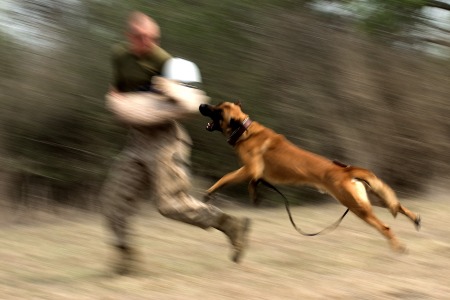
A military dog training at Lackland Air Force Base, Texas / DoD photo
The Pentagon is cracking down on the data it posts on its websites. The latest example: the Army manual on its use of dogs. The 2005 version used to be public, but it has been scrubbed off Pentagon websites, according to Steven Aftergood of the Federation of American Scientists (although he managed to snare a copy, which you can read here). But the manual has just been revised – following a dog’s starring role in the SEAL strike against Osama bin Laden, it was sure to be well-read – but the new manual is available only to Pentagon officials and their contractors, according to Aftergood.
It’s part of an Obama Administration policy to bar increasing amounts of information to the public who pays for it. I don’t know about you, but I was curious to see if the revamped manual updates Section 5-31, Apprehension of Subjects:
The use of Patrol Dogs [PD] to attack and hold an individual enemy or terrorist should not be overlooked. A PD can be sent into a building, confined space, or cave to find, attack, and hold an individual until the handler and friendly forces can arrive to place the subject into custody. Although disadvantages do exist (injury or death of the PD), the PD is better-suited than a human to immediately find and subdue a subject in an area where the interior structure is unknown to friendly forces.