
As China Rises Militarily, Eventually the Golden Rule Should Be Applied

Let's get to the real confidence building joint exercises
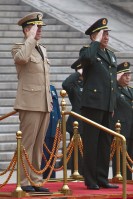
U.S. Admiral Mike Mullen (L), chairman of the Joint Chiefs of Staff, and General Chen Bingde, chief of the General Staff of the Chinese People's Liberation Army, salute during a welcoming ceremony for Mullen at the Bayi Building in Beijing July 11, 2011. REUTERS/Alexander F. Yuan/Pool (CHINA - Tags: POLITICS MILITARY)

Wash Times piece on Chairman of the Joint Chiefs Admiral Mike Mullen’s counterpart in China (Chen Bingde) saying that US naval ex’s in regional waters with local friends (Vietnam, Philippines, etc.) are “inappropriate.” Mullen replies that they’re not directed at China, which, of course, is the whitest of lies. The US sells beaucoup arms to all the same players and exercises with them to give them confidence vis-a-vis “rising China.”  Fair enough.

But if you want China to play “responsible stakeholder,” you need to invite it to your reindeer games, and naval ex’s are perfect for this. So why doesn’t the US invite the People’s Liberation Army Navy to every such ex? They check us out; we check them out. Transparency is heightened, etc.

Think about it from the golden rule perspective: don’t do to China in its regional waters what you wouldn’t accept from it in your own. Eventually, we must move to this standard so we can move beyond this petty, small-steps phase that we’ve been stuck in for several decades now. We treat China like a potential enemy and so it acts like one. We want Beijing to grow up, but we need to do a bit ourselves. We need to move beyond the need for the “near-peer competitor” planning paradigm.

Related Topics: China, navy, China, Navy
  • Latest on Battleland

    MANDEL NGAN/AFP/GettyImages

    Only One Year of U.S.-Led Fighting Left

    President Obama’s goal at the NATO summit this week is looking increasingly clear: wrap up U.S. troops’ combat role over the coming year, and get the allies to pay more money to enable the Afghan military to fill the gap.

    Getty Images

    House Pushes for East Coast Missile Shield

    The House has approved a $643 billion defense-spending bill for 2013 that’s $3.7 billion more than the Obama Administration, and its Pentagon, is seeking. That’s just about the same amount the Congressional Budget Office estimates the House bill’s push for an East Coast missile shield will cost over the next five years.

    Photo by Ron Sachs-Pool/Getty Images

    The Pentagon’s “Washington Monument Strategy”

    Whenever federal bureaucrats running the nation’s parks get antsy that their purse is likely to shrink, they roll out something long known as the “Washington Monument strategy.” That’s the tried-and-true technique of warning the public that if money isn’t forthcoming, one of the first budget cuts will force the shutting down of the popular obelisk to Washington, D.C., tourists.

blog comments powered by Disqus