
Think Outside the Defense Budget: The Real Cost of Keeping China Our Enemy

Mark Thompson picks up on Chins’s cheeky advice to visiting Chairman of the Joint Chiefs Admiral Mike Mullen regarding our coupling of world-class defense spending with our world-class national debt/faltering economy.  We can brush it aside, of course, seeing that it’s coming from our #1 excuse for defense spending (Mustn’t let those Chinese . . . ).
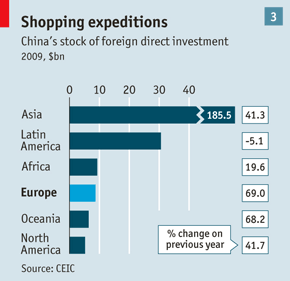
Follow the money

But Americans would do well to consider the ancillary costs of this approach with China. See the Economist chart depicting the cumulative stock of Chinese foreign direct investment around the world. Despite having lots of commodities and companies and technologies that China would love to invest in, North America ranks last. Even in this bottom-feeding period of Western distress, the growth of Chinese FDI into Europe is almost twice that into the US.

Yes, there is just as much popular angst about China’s rise in Europe, but right now they’re getting the shot-in-the-arm direct investments from China that we are not. What Chen Bingde should have said was, “How that demonizing-your-banker-thing working out?”

Related Topics: China, defense budget, defense spending, China
  • Latest on Battleland

    MANDEL NGAN/AFP/GettyImages

    Only One Year of U.S.-Led Fighting Left

    President Obama’s goal at the NATO summit this week is looking increasingly clear: wrap up U.S. troops’ combat role over the coming year, and get the allies to pay more money to enable the Afghan military to fill the gap.

    Getty Images

    House Pushes for East Coast Missile Shield

    The House has approved a $643 billion defense-spending bill for 2013 that’s $3.7 billion more than the Obama Administration, and its Pentagon, is seeking. That’s just about the same amount the Congressional Budget Office estimates the House bill’s push for an East Coast missile shield will cost over the next five years.

    Photo by Ron Sachs-Pool/Getty Images

    The Pentagon’s “Washington Monument Strategy”

    Whenever federal bureaucrats running the nation’s parks get antsy that their purse is likely to shrink, they roll out something long known as the “Washington Monument strategy.” That’s the tried-and-true technique of warning the public that if money isn’t forthcoming, one of the first budget cuts will force the shutting down of the popular obelisk to Washington, D.C., tourists.

blog comments powered by Disqus