




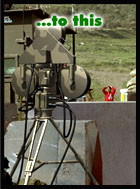
This Pentagon purchase caught my attention Wednesday night: the Army has awarded Science, Engineering and Technology Associates of Arlington, Va., a $48.2 million contract for “the procurement of the counter-bomber system to provided detection capability of suicide bombers approaching a controlled access site.” The company says “the SET CounterBomber® system integrates radar and video to yield the first-ever system capable of automatically detecting suicide bombers at safe distances.” Wonder if it can detect those implantable al Qaeda bombs ABC, CBS and NBC scare-mongered the nation with Wednesday night? (Oops — apparently not — the promotional material notes CounterBomber® is “Private: non-imaging radar won’t reveal underlying body structure.” OK — back to the drawing boards, people — there’s an improved version to be developed!)
The company describes itself as “a small, privately owned business founded in 2002 by scientists from the Defense Advanced Research Projects Agency.” That’s the Pentagon’s taxpayer-funded R&D lab. That all changed, though, in 2010 when the decidedly not-small, not-private, Science Applications International Corporation bought it. SAIC (a Fortune 500 company whose shares trade on the New York Stock Exchange) was the Pentagon’s 10th biggest contractor last year, with $5 billion in military revenues. Not sure which is more disconcerting — the evolution of this company (“one bid was solicited, with one bid received,” the contract award notes), or its promise to detect suicide bombers “at distances greater than 100 meters.” As they said, sort of, about baseball: if you pay for it, they will come.