



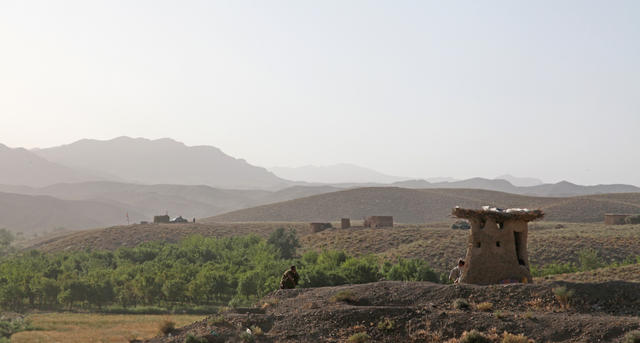
Afghan border police at a post along the Durand Line in Kandahar province last month / Army photo by Joseph Johnson
The historically-porous frontier dividing Afghanistan from Pakistan — all 1,600 miles (2,400 km.) of it — has long been easily crossed by Taliban fighters seeking to attack U.S. troops in Afghanistan, who then withdraw back into the relative safety of Pakistan. If that constant border crossing isn’t headache enough for local commanders, there’s a pair of stories out Tuesday that detail looming internal threats on both sides of the 120-year old Durand Line. (Named in 1893 for Henry Mortimer Durand, the foreign secretary of British India, the line imprecisely divides Afghanistan from British-ruled India, which included Pakistan at the time).
Afghanistan’s threat is today’s — that posed by Taliban sympathizers embedding themselves in the Afghan military. Pakistan’s threat is tomorrow’s — the growing chance that Islamic radicals will capture one of Pakistan’s growing arsenal of nuclear weapons.
The New York Times has a front-page story Tuesday morning on the threat posed by Taliban infiltrators in the Afghan army:
As NATO hurries to build an Afghan security force of nearly 400,000 members by the end of 2014, Afghan military and intelligence officials concede that the task of screening the more than 8,000 army and police recruits who enlist each month is monumental…“There’s a major effort to turn Afghans once they’re already inside the security forces, as well as a push to infiltrate existing militants into the ranks,” said a senior United States military officer who is helping to oversee the influx.
There is nothing more depressing for soldiers than to fear your purported allies, and stories of Afghans turning on, and killing, U.S. and fellow Afghan troops are becoming distressingly common. And that’s the good news. The bad news is happening next door, where according to Tuesday’s British Telegraph:
Pakistan ‘can’t protect atomic arsenal from Islamic extremists’
The piece, filed from Islamabad, goes on to cite a just-issued report from West Point’s Combating Terrorism Center declaring that “several worrying trends in Pakistan…are coming together to suggest that the safety and security of nuclear weapons materials in Pakistan may very well be compromised at some point in the future.”
Shaun Gregory, director of the Pakistan Security Research Unit at Britain’s University of Bradford, is the author. It’s pretty straightforward: a growing Pakistani nuclear arsenal, tended to by a growing number of technicians, scientists and soldiers, means the chance of a nuclear weapon falling into terrorists’ hands “is no longer an implausible event.”
In the 30 years of covering nuclear non-proliferation, I always find it surprising how much more concerned the Europeans seem to be about this than Americans are. But this article in the latest issue of the CTC’s Sentinel takes the yellowcake: a British researcher warns of the threat, and that warning is amplified in a London newspaper — via the U.S. Military Academy at West Point.
Are the Brits exaggerating the threat? Perhaps. Are we downplaying it? Maybe.