



Late last year I wrote a piece about an effort spearheaded by George Clooney to spin a bunch of commercial satellites over Sudan. The idea was to take detailed pictures of the border area between the North and South in case civil war broke out as the country split in two, as it is set to do in July. The idea was that the spotlight might help prevent war and atrocities. The last civil war in Sudan ended in 2005, but not until 2 million people died. Sudan’s president, Omar al-Bashir, has been charged with war crimes.
Clooney’s project combines Hollywood money to task the satellites, UN experts to comb through the imagery, and analysts at Harvard Humanitarian Initiative to compare the data to ground reports. The Satellite Sentinel Project is up and running — and doing some astounding work. Sadly, the project has been forced to move from trying to prevent war in Sudan to documenting it as it seems to be unfolding. War is breaking out in the heavily contested town of Abyei, which straddles the border between the North and South. Already, 25,000 people have reportedly fled the violence unfolding there.
The project has a new, startling report out, complete with images of tanks and planes and artillery and burned villages. You can peruse and download it at their site.
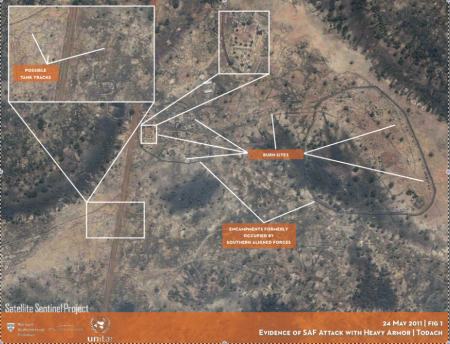
A satellite image of Sudan from George Clooney's satellite project
The report documents a razed southern-aligned military base, and fires burning in the town of Dungop where northern-aligned forces have attacked. Clooney’s group has also shown where the brutal northern militia, the Misseriya, have decamped and moved south. The images document tanks, tank tracks, artillery, and aircraft the North is using to pound targets in and around Abyei.
Human rights workers say this is the first time satellite technology has been used by private groups to deter and document war crimes and atrocities in real-time quite like this. Clooney told me late last year he wanted to become “the anti-genocide paparazzi.”
“We want them to enjoy the level of celebrity attention that I usually get,” he said about potential perpetrators of war crimes. “If you know your actions are going to be covered, you tend to behave much differently than when you operate in a vacuum.”