



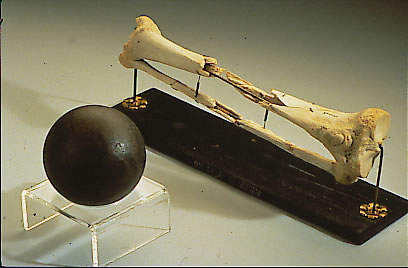
Sickles' right leg, and the type of cannon ball that severed it / National Museum of Health and Medicine
Every other day in Afghanistan or Iraq, a U.S. soldier or other service member loses a leg or arm to an IED, or other kinds of battle trauma. In 2010, the rate of 16.4 amputations per month was more than double the 2009 rate of 7.3. That’s a growing audience for the latest item slated for display at the U.S. Army Medical Research and Materiel Command at Fort Detrick, Maryland: the amputated leg of Union Major General Daniel Sickles.
On July 2, 1863, at the Battle of Gettysburg in western Pennsylvania, Sickles was astride his horse, marching Third Corps along a ridge, without approval, when a cannonball shattered his right leg. As medics carted Sickles from the field, he puffed a cigar and waved to bolster morale among troops already devastated by the losses in the Confederate attack. The Union held its line that day, but Sickles lost his leg. He returned to private life with a carefully preserved personal reminder of the sacrifices made in war.
…says a statement from the command. “The National Museum of Health and Medicine has graciously loaned us this historic treasure,” adds Major General James Gilman, who heads the command. “It’s amazing to see how far military medicine has advanced.” The museum lent the command the leg as it moves to a new location from its current spot on the Walter Reed campus, where many troops with amputations go to be outfitted with the latest in artificial limbs.